

Thursday, February 26, 2009

PERSVERKLARING:BETOGING BRUSSEL 7 MAART 2009

BETOGING BRUSSEL 7 MAART 2009 Met 10.000 naar Brussel voor Catalaans Zelfbestuur!
Het initiatief "10 Mil a Brussel•les per l’Autodeterminació" (Met 10.000 naar Brussel voor Zelfbestuur) is ontstaan uit het brede maatschappelijke middenveld in Catalonië en snel gegroeid dankzij de actieve medewerking van vele wakkere Catalaanse burgers op regionaal en lokaal niveau. De bal sloeg aan het rollen na de publicatie van een artikel van de hand van professor Enric Canela op een blog dat publiceert over Catalaans zelfbestuur. De vele reacties van lezers op het internet zorgde al snel voor een sneeuwbaleffect van enthousiaste initiatieven via Facebook, blogs en websites. Via het aldus ontstane digitale platform werken we samen om op 7 Maart in Brussel, zetel van het Europees Parlement, met 10.000 Catalaanse burgers te gaan betogen voor het recht om een eigen onafhankelijke staat te kunnen zijn zoals andere volkeren in Europa. We willen ervoor zorgen dat het zelfbeschikkingsrecht van Catalonië op de Europese agenda wordt geplaatst. We willen dat de Catalaanse politieke partijen, gedreven door ons initiatief, zich officieel voorstander verklaren van een onafhankelijk Catalonië in een verenigd Europa. Ons platform is niet onderworpen aan een bepaalde politieke ideologie maar staat integendeel volledig open voor alle organisaties en burgers die tesamen met ons willen ijveren voor de onafhankelijkheid van de Catalaanse natie.
De betoging heeft plaats in Brussel op Zaterdag 7 Maart 2009 en start om 10u aan het Noordstation.
Meer info over ons initiatief vindt u hier :
* De officiële website :
http://10mil.cat/
* Uitgebreid persdossier in het Nederlands :
http://10mil.wordpress.com/pers/
* Het speciaal voor de betoging gemaakte lied "Som 10 000 a Brussel•les" van de Catalaanse
zanger Gerard Sesé :
http://www.youtube.com/watch?v=CWiPfi9wPDU
* Promoclip voor de betoging :
http://www.youtube.com/watch?v=SLYj6NY-a8U
* Foto’s :
http://www.flickr.com/photos/35254226@N04/
Aarzel niet ons te contacteren voor meer achtergrondinformatie, interviews, fotografisch
materiaal,...
Vriendelijke groeten,
Voor de persdienst van het organiserend comité 10MIL.CAT,
Manel Bargalló,
Josep Poveda.
Contactinfo ( in het Engels of Catalaans ) :
# In Brussel : Estela Rodríguez estelrodri@gmail.com
# In Catalonië : Elisenda Paluzie epaluzie@ub.edu
+34 93 403 44 09 (bureau) +34 626 79 02 30 (mobiel)
# Internationaal bureau : casalscatalans@deumil.cat
# Pers : premsa@deumil.cat
Wednesday, February 25, 2009
COMMUNIQUÉ DE PRESSE
COMMUNIQUÉ DE PRESSE
Des milliers de catalans manifesteront pour l’autodétermination de la Catalogne, le 7 mars prochain à Bruxelles.
L’INTERNATIONALISATION DU CAS CATALAN MET EN RELIEF LES DIFFICULTES DE L’ETAT ESPAGNOL POUR RESOUDRE DES PROBLEMES IMPORTANTS
CONFLICTS NATIONALS
Pour la première fois, une initiative sortie de la société 2.0 (web 2.0), à travers des nouvelles technologies comme les réseaux sociaux virtuels (en ce cas Facebook) est en train de se faire réalité. Cette initiative sortie d’internet n’est liée à aucun sigle ou parti politique spécifique, même si nous avons obtenu des soutiens de politiciens, de la plupart des plateformes citoyennes, entités culturelles, écrivains et collectifs sociaux de tout genre. Entre autre, l’ancien porte parole du Conseil général du Pouvoir Judiciaire espagnol, le notaire catalan Alfons López Tena, auteur du récent livre « Catalunya sota Espanya. L’opressió nacional en democràcia » (Dèria editos- La Magrana 2007), un livre polémique et un succès de ventes en Catalogne.
Les catalans, comme toujours au long de leur histoire, seront innovateurs. Et la manifestation à Bruxelles sera un exemple.
Manel Bargalló
Josep Poveda
Presse: premsa@deumil.cat
jp.premsa@deumil.cat
Autres liens d’intérêt.
Tamazgha.fr: Dix mille manifestants à Bruxelles pour l’autodétermination du peuple catalan
Publié le mercredi, 25 février 2009
Dix mille manifestants à Bruxelles pour l’autodétermination du peuple catalan
Manifestation à Bruxelles le samedi 7 février 2009 à 11h.
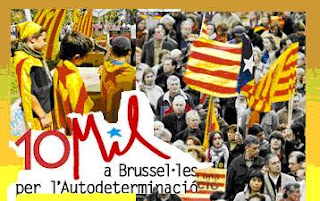
Dix mille manifestants à Bruxelles pour l’autodétermination du peuple catalan
Manifestation à Bruxelles le samedi 7 février 2009 à 11h.
Des associations catalanes appellent à une grande manifestation à Bruxelles le samedi 7 mars 2009 à partir de 11h pour s’exprimer en faveur de l’autodétermination du peuple catalan. Solidarité Tamazgha-Catalogne

C’est avec le slogan de "Dix mille à Bruxelles pour l’autodétermination" que les Catalans défilerons à Bruxelles le samedi 7 mars 2009 à partir de 11H.
Solidarité Tamazgha-Catalogne
L’association Tamazgha soutient cette action et exprime sa solidarité au peuple catalan dans son action en faveur l’autodétermination.
Tamazgha appelle Imazighen de Bruxelles, de Belgique et des pays voisins (Pays-bas et France notamment) à se joindre, nombreuses et nombreux, à cette initiative pour manifester aux côtés des Catalans à Bruxelles le samedi 7 février 2009.
C’est une occasion également pour nous d’exprimer notre attachement à l’autodétermination des peuples et dire au monde notre volonté de nous inscrire dans un combat de libération nationale du peuple amazigh pris, depuis des siècles, par les griffes de l’arabo-islamisme qui a programmé son éradication.
Et que les drapeaux amazighs soient brandis ce samedi 7 février aux côtés du drapeau catalan pour exprimer la solidarité amazigho-catalane.
Pour plus d’informations à propos de la manifestation catalane à Bruxelles
EU Minority in support of 10.000
ACTUALITÉ • LES BRÈVES D'EUROMINORITY
10 000 Catalans invités à Bruxelles pour l'autodétermination en mars prochain[24/01/2009]
Ce qui a commencé comme un simple fil de commentaires sur un blog s'est transformé en une mobilisation qui a poussé des milliers de Catalans à Bruxelles pour y réclamer le droit à l'autodétermination. La plate-forme Deumil.cat a présenté hier la campagne pour réclamer dans la capitale européenne un référendum sur l'indépendance en Catalogne.
Enric Canela, un des promoteurs de l'initiative, a déclaré que l'objectif de la mobilisation est d'"internationaliser le conflit qui a lieu en Catalogne", afin qu'il apparaisse "au yeux du monde". En tête de cortège, on pouvait lire : "Nous devons réussir à organiser un référendum sur l'autodétermination". Les promoteurs de la campagne souhaitent qu'il s'agisse d'une initiative de la société civile et non directement des partis politiques, lesquels sont invités à s'y associer.
Selon la plate-forme, maintenant le moment est venu de poser la question du référendum, parce que la réforme statuaire a conduit le pays "dans une impasse". Pour Deumil.cat, il s'agit simplement que la Catalogne soit dotée d'un état propre, étant donné qu'en Europe actuellement "seuls les États y sont reconnus".
La mobilisation, qui utilise massivement les outils Internet comme les blogs ou Facebook, veut réussir à ce que 10.000 Catalans se mobilisent à Bruxelles le 7 mars prochain et y réclament le droit de décider de l'avenir de la Catalogne, lors d'une manifestation qui parcourra les rues de la ville flamande.
L'initiative de Deumil.cat est apparue après que l'article "Perplexe, moi ?", d'Enric Canela, publié en septembre dernier sur le blog Grand du Sobiranisme, ait suscité un bon nombre de commentaires des lecteurs.
Article traduit du catalan : MónDivers.cat est partenaire d'Eurominority.eu
(Source : MónDivers)
Singapore democrats note 10.000
http://yoursdp.org/index.php/news/nonviolent-action-news/europe/1960-nva-in-europe-2009-february-21
10 thousand in Brussels for self-determination
By: European Free Alliance, February 17, 2009
10 Thousand in Brussels for Self-determination", this is the name of the manifestation organized by Catalan organisations, that will take place in Brussels on the 7th of March. The initiative came from a spontaneous reaction of catalan people to the article "Bewildered, I?" in which the author Enric Canela highlights the current political situation in Catalunya and asks himself if it would be possible to bring thousands of people in Madrid to defend the right of Catalans to self-determination, as the American people led by Martin Luther King did in 1963, when 200.000 people met in Washington to defend the rights of black people.
INTERVIEW TRANSCRIPT:‘10 thousand Catalans to Brussels’ with Professor Enric I. Canela

‘10 thousand Catalans to Brussels’ with Professor Enric I. Canela
To listen the interview click in this link http://webcast.deumil.cat/
In just a few days time, on the 7th of March, Catalonia, a stateless nation in the heart of Europe, is ready to march to Brussels in a gesture to show its determination for Independence. ´Ten thousand Catalans to Brussels`, is the name given to this iniciative, borned from the very social fabric of Catalunya. Today we ask professor Enric I. Canela, head of the BioChemistry and Molecular Biology at the University of Barcelona, and one of the main figures behind this social movement, why is that Catalans feel the need to be marching to Brussels and what is that europeans, and other citiziens of the world, can do to support their right to decide their own fate.
1. Interviewer: 10,000 Catalans marching into Brussels are a lot of people. This initiative must therefore have a lot of support. What is going on in Catalonia?
1. Enric I. Canela: Catalonia has always been a different nation to the country of Spain and that’s the reason why we have so many different traits. A recent illustration of the Spanish fixation for not letting Catalonia live fruitfully within her rights is back in 1981 when a coup was attempted by the Spanish military, led by a follower of the deceased dictator Franco. At that time, it was the beginning of the Spanish democracy and the coup was a reaction to talks that were taking place between Catalonia and Spain to develop the idea of a co federation status, a dual power status between Catalonia and Spain. Step by step, as years have passed, we’ve come to realise that this will never be possible and so in 2005 the Catalan Parliament approved the Catalan Estatut, a type of constitution but this has been completely dismissed by the Spanish Government and will shortly be sentenced by the Spanish Courts to mean nothing at all. All of this has driven Catalan people to say enough is enough and our frustration is now manifesting itself in very clear ways, louder than ever before. Now the determination for independence from Spain is getting very alive and strong.
2. What type of people supports the independence? Which type of people would come to Brussels on 7 March?
2. I think if we consider the people that have joined this manifestation so far, we can safely say that they come from all corners of Catalonia and all walks of life. We have business people, professionals like doctors, lawyers, we have workers, butchers, the young, the elderly. Just people who feel that the independence of Catalonia is the only way for our people, for our culture.
The march is not branded by any political party but we have received the support of individuals from all of the nationalist political parties of the country.
3. What would your ideal outcome of the march be?
3. We have 2 objectives. That Europe, the world, acknowledge that in Catalonia we live in conflict, not armed conflict perhaps but none the less we live in constant conflict. So we aim for the internationalisation of the conflict, we want the media, the politicians, the citizens of Europe in general, to acknowledge what is happening here in Catalonia, on their doorstep. Following from that, getting the conflict out in the open, we wish to ensure that the local Catalan politicians have to consider that a great number of people are now demanding the final independence of Catalonia. We want to force them to take this into account and make it become a political reality and in doing so therefore, the Spanish politicians will have to end up negotiating on the conflict, instead of simply ignoring it for their own benefit.
4. Do you hope for European understanding? Is it not enough that we all are just Europeans? Why do you need a strong nationalist?
4. We Catalans have great tradition. First of all Catalonia has a culture, a language that are as distinct and unique and different as all of the other different European languages. We’ve maintained it and preserved it for centuries. It’s worth considering that Catalonia had the first European Parliament, even before the English, which was the cradle of all of the European democracies that we have today. Therefore we have a great tradition of being a fully functioning and distinctive nation and a political state by itself that goes back as far as the 8th Century and the legacy of Charles the Great. This capacity that we have for self government has been maintained for all of those centuries right up to the configuration of the Spanish co federation at the beginning of modern times. We Catalans have been subject to endless wars in which we have regularly been defeated by a larger army but we have to understand here that there’s not always been a united nations, historically the bigger the territory, the bigger the army and as a result of these defeats we’ve had our culture persecuted and our language banned. In recent times this persecution peaked after the Spanish Civil War when all the Catalan bodies of governments and the Catalan Republic were dissolved by Franco. Franco, the fascist dictator, winner of the Spanish Civil War, maintained a very tight alliance with Hitler and Mussolini and they and their fascist agenda stepped over Catalonian free doers and restarted heavy persecutions. Finally, when the dictator died and democracy arrived to Spain in 1975, there was created a constitution where Catalonia once again aspired to establish a bi-lateral power status on the form of a cofederation but again little by little the situation eroded as I explained earlier. We have the right to protect our language, which now, although spoken by 7 million people which is many more than some other recognised European languages, Catalan is still considered a second class language. In order for us to maintain our different traits, our culture as a nation, we need our own state.
5. Professor Canela, what would you say to a European citizen, Finnish for example, or an Austrian person, who is not aware of your conflict and therefore indifferent towards your cause?
5. Maybe I would turn my thoughts to the history of the Nordic countries for example and how the Swedish crown established a separation of the Nordic states in order to preserve each of their own different national identities, leading to what we now know as the modern Scandinavia. Or I would recall how Czechoslovakia, via a mutual understanding created 2 different independent republics, the Czech Republic and Slovakia. The first reasons for Europe to exist is to be the people’s Europe. The Europe of the states has no future because it will only represent the interests of those with enough power to pressure, they will not represent the real needs of the European citizens. By helping to protect the rights of other European countries, you ensure your own rights are protected. Europe’s great strength has always been in its cultural diversity and the innovation and the creativity that it generates. The greater number of strong and independent European cultures that are allowed to flourish, the better.
6. Catalans have a long history fighting for their freedom, why are you still part of Spain? Which are the main reasons?
6. There are mainly 2 reasons. Firstly, prior to globalisation, it was in the economical interests of the elite within Spain to maintain the Spanish internal market and here therefore there was always this terrible fear of losing the privileges if Catalonia and its citizens stopped being part of this market. Secondly, there are the continuous wars that we’ve been engaged in fighting to defend ourselves since the 17th Century. Wars that we have unfortunately lost because of more formidable powers to our borders. Portugal for example, only got the chance to be independent because Spain chose to direct its fighting efforts towards keeping hold of Catalonia instead of fighting on both fronts. Following all these centuries of battle and struggle, suffering and resistance against this aggressive attitude towards Catalonia, we arrived to modern times and the fascist alliance of Franco, Hitler and Mussolini which as you may imagine made very harsh times for our people. The guns have always been the method to keep us but in the end all these forced relationships have to end up breaking.
7. What disadvantages do Catalan people experience every day as a result of being under Spanish rule?
7. One of it is economical. Catalonia has always been by far the most developed region in the Iberic peninsula, that the wealth that Catalonia generates is unfairly distributed among the less productive territories of Spain and as such Catalan citizens actually end up receiving less benefit than the citizens of the regions which don’t produce nearly as much and that’s a well known fact.
What problems does this produce? Well if Catalonia doesn’t have enough resources to reinvest, we lose the capacity for development. In practical terms what this means for example, is that Catalonian citizens have more problems to have schools and hospitals compared with other regions, when it is in Catalonia where the vast majority of the resources are generated. Another clear example, one that I know very well as a professor of a university, universities in Catalonia are run by the university rules that the Spanish Central Government decides. These rules prevent our productive development. Right now for example, all of Europe is working towards a standard for higher education. Europe has decided for a 3 year bachelor course. Spain have not. They’ve decided on a 4 year bachelor course. Catalans can’t do anything about that and the homogenisation of our students with other European students is now in jeopardy. We don’t have either the flexibility to decide upon salaries in order to attract and hire professors or researchers coming from other countries. We can’t develop our own research centres without the resources that have been taken from us by the Spanish Government. As you can imagine it’s a very frustrating and very difficult situation. We can’t attend to the migration from other countries because it is an area managed by the Spanish Government. In reality, in practical terms, we cannot do anything without the permission or without a law that is for all of the rest of the Spanish territories that does not take into consideration the possibility of differences in needs. This generates situations which makes us lose competitiveness, resources, capacity for reaction, capacity for development etc.
8. How is it that there is still such national identity, what do you attribute with that to?
8. When transportation was slower and less available, language was a natural frontier and as any other European nation that has had a language develop in a different way to another, it creates a community that holds different traits to another. Catalonia has always been a land of passing for many different cultures which impacted upon our own. Meanwhile in other areas of the interior of the Iberic peninsula this didn’t happen. All of this created the very different culture, the more European facing culture that is the Catalan culture that we have today. However, these days the problem arises when Catalonia media is under a constant submission to the vast quantities of Spanish media, TV, news etc. Because language is so important and the Spanish nationalism is very active with lots of means at its disposal, we find ourselves empty handed in order to prevent the slow erosion of our culture. With globalisation, it’s only these natural frontiers, like language, that can assure the survival of one’s own culture. Therefore, now more than ever, we need the right to promote our own identity.
9. Catalonians have made a lot of progress on their own, without external help already. For example Catalan is a language used to teach in all schools in Catalonia. Recently the Spanish Police (Guardia Civil) have been removed. So why is total independence still so important?
9. To keep the language and the culture. Yes the school system is in Catalan but it’s also true that these days we find ourselves in a very different situation than a few years ago. Although Catalan is spoken in the schools, Spanish is increasingly the language on the street due to massive immigration which is mainly coming from South America. This is a phenomena that a few years ago we didn’t have and it’s a very serious problem for the continuity of our language unless we can create and regulate the mechanism that could guarantee the survival of our language. This is a problem that immigration does not cause in countries who are in charge of their own language of course. It is totally impossible that with a system as the one that we have today working within the Spanish state, that Catalonia can keep on being innovative, that we can keep on attracting foreign capital and have the position to be a decision-making centre. This is progressively more and more difficult because the tension that Madrid provocates is enormous. If Catalonia is to be a developed country in the next 25 years it is a prerequisite that we must have our own state.
10. So why does Spain not give you the independence?
10. The departure of Catalonia would mean a decrease in the capacity for other parts of Spain to develop, in the way that we are a factory, the benefits of which are pocketed on other territories by other people. I’ll give you an example. Catalonia had 2 robust, very important electric companies. These 2 electric companies were simply taken by the Spanish Government, made into one, which was then headquartered in Madrid. A company headquartered in Madrid, who had all its clients in Catalonia. This doesn’t make any sense at all. The national spirit of the Spanish Government is very strong. Another example happened in the País Basc with one of their main banks. The Spanish simply proceeded to join it with a Spanish bank and again headquartered the bank in Madrid when it had been traditionally a Basc bank. I mean it’s like a genetic sense of possession which makes it unavoidable that these strong tensions arise. Spain will never, without external pressure, accept our independence.
11. Why can’t this go to referendum amongst the people in Catalonia?
11. Because of a very easy legal reason. Referendums can only be authorised by the Spanish central power and it’s the Spanish state who end up deciding what is that Catalonia wants to be.
What it is that Catalonia has the right to be can only be decided by the whole Spanish state, by the opinion formulated by all the citizens of all the Spanish territories. The right to decide is not a right owned by the Catalans. The Spanish as a whole will never accept in any way shape or form that Catalans could express their desire by referendum. It’s a question of saying, we have the capacity to decide if you guys can make a referendum and we just don’t want to let you. Plain and simple.
12. And finally Professor Canella, what could the European citizen who agrees with your right to freedom, do to help?
12. Well it helps that people just understand what is the situation that Catalans live under. In
Canada, in Quebec where French is spoken, Quebec can call a referendum in which the people of Quebec can decide if they wish to be independent or not and the French citizens are absolutely in agreement with that right. Are the French citizens in agreement that a referendum could be held in Catalonia? Why is one different than the other? There they speak French regardless that the rest of Canada speak English. So why can the same reasoning not be applied here in Catalonia. We therefore simply ask for the support of the European citizens for us to be allowed to hold a referendum. We don’t ask for them to decide if Catalonia has to be independent or not, we are only asking for European citizens to agree with the fact that the people of Catalonia, should be allowed to decide for themselves, if they want their nation to be independent or not.
………………………………………………………………………………………………………………….
Thank you very much.
For any comments or feedback please do not hesitate to contact us at,
Tuesday, February 24, 2009
PRESS DOSSIER: 10.000 in Brussels for self-determination of the Catalan Nation

10.000 in Brussels for self-determination of the Catalan Nation
Help us make a firm step towards independence
Inntroduction and objectives
The Catalan Nation is a nation without a state with over one thousand years of history, and most of whose territory is now within the Spanish State. It has an official population of 13 million inhabitants, with its own language, broad, comprehensive literature, and a service- and industry-based economy with a GDP of $482 bn. representing 30.5% of Spain's GDP and a per capita GDP of over $37,000.
Historically, the Catalan nation has been a great European power, and in the 14th century was the most powerful nation in the Mediterranean. However, in the early 18th century, Catalonia lost its independence in a war against an alliance between Spain and France.
For over 300 years now, the Catalans have not ceased trying to recover their freedom, and even through wars, political persecution and forty years of fascist dictatorship during which its language and culture were downtrodden, the Catalan identity remains firm and we are unwavering in our claim to recognition for our own state in Europe.
Catalan civil society, in the form of cultural, sports and civic institutions, constantly takes action in initiatives to demand our right to self-determination as a European people.
Ten Thousand in Brussels for Self-Determination of the Catalan Nation is an example of aSociety 2.0 initiative. It arose in response to the article Perplex, jo? (Perplexed, me?) posted by Enric Canela in the Bloc gran del sobiranisme (Sovereignty's Great Blog) on the 6th of September, 2008, and the readers' comments, from which the initiative immediately began its propagation via a Facebook group and our deumil.cat website.
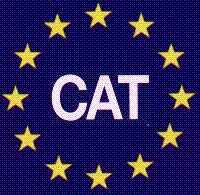
This platform is the basis from which we are working together for the consolidation and eventual success of our aim: we are all going to Brussels on the 7th of March to our common call: "We want our own State", claiming independence for our country.
We want self determination for the Catalan nation to figure on the international agenda and that of our nation's political parties, driven by our force, that they declare formal support for independence and include it in their programmes. Furthermore, we want them to commit to working towards achieving it.
Who we are addressing
The initiative for Ten Thousand in Brussels for self-determination of the Catalan Nation is of atransversal nature and is totally open to the individual citizen as well as to the associations that make up our civil society that show their commitment to the defence of the Catalan language, its culture and nation, and especially to the citizen platforms that have lately stood out in the largest mobilizations in response to the aggressions to our freedom, claiming the right to decide. But we are also addressing professionals, trade unionists and social agents who have understood that the defence of their positions and of their industries goes hand in hand with greater freedom and capacity for the country to decide its own policies.

But above all, we are conscious that we are mainly addressing Catalan citizens who, tired of their not being heard, want to make clear with their own voice in Europe and the world our wish to be an independent nation.
This project, which is not subject to any particular political group or party, is open to allindividuals, organisations and platforms to work together, maintaining their independence, but with a common objective: the Independence of the Catalan Nation.
Why now?

Now that we live in an ever more globalized world, Catalonia, and by extension, all the Catalan-speaking countries, is coming to a difficult, disconcerting crossroad. The constant submission during three-hundred years of our nation by the Spanish State constitutes the greatest burden for our development, and further, it endangers our survival as a nation within Europe where only States are recognised.
The time has come. The cul-de-sac we have been led into by the recent Statutory reforms, the Miravet Statute, passed in 2006 after several serious cutbacks (and which is currently in the hands of the Spanish Constitutional Tribunal which clearly intends to limit the competencies still further), ought to make the whole of our country's political class and civil society that wants a better future think very seriously. The time has come for the Catalans to decide on our future, it is time to become sovereign as a fully recognised nation in the international context, so we can deploy all our collective capacities.
Over the last years, the political environment, whether Catalan, Spanish or European, has taught us that there is no other alternative for us to be Catalans with the same rights and duties as other European peoples who have their own state. That is why we have to go to Brussels to demonstrate our will to become a European Union member state.
Organization

In order to make this event possible, we need the participation and the commitment of the largest possible number of people and organisations. So as to coordinate all the activities and, above all, to guarantee the success of the event, the platform has been constituted by a council with limited membership, and is responsible for the coordination of the action points in order to get as many Catalans to Brussels next March 7th.
Each member responsible for an action point is free to create as many volunteer networks as they deem necessary, and each volunteer network can set up further networks. The council is permanently in touch via the deumil.cat website.
The action points set up so far are:
- Relations with Institutions and Political Parties
- Relations with other Catalan pro-Sovereignty and Cultural Platforms
- Logistics and Transport to Brussels
- Communication and Promotion
- Territorial Deployment of the Volunteer Network. One delegate is planned for each Catalan town and also in others cities worldwide.
- Virtual Management and the Internet
The documents required for the establishment of the Deumil.cat association have been submitted to the Generalitat de Catalunya (Catalan government).
Participation in the project
The success of the project lies in the participation of the greatest possible number of people ready to work during the coming months in order to mobilise thousands of Catalans to take part in the demonstration in the streets of Brussels.
We are therefore requesting your commitment to this project, whether you can attend personally or not. There are many ways in which you can act and collaborate: making the march known via the media, preparation of public events far and wide, organising activities, making contacts with the press and other media, attending meetings with volunteers, etc. Any activity will help with making the project publicly known and making people aware of the situation.
One example is signer-songwriter Gerard Sesé's chant or hymn for the "Som 10.000 a Brussel·les" initiative, which you will find on You Tube, MySpace, Facebook and which you can also download from the Deumil.catwebsite.
There is also a promotional video at:
http://www.youtube.com/watch?v=SLYj6NY-a8U&eurl=http://deumil.cat/index.php?;action=login2
You can register at the deumil.cat site, joining the sections or action points. Above all, we request volunteers to set up territorial networks, not only in the Catalan-speaking countries, but also worldwide.
Each of the territorial delegates will be responsible for communicating information on the project, preparing public or media events in the territory, and above all, filling a coach, a plane or a train, depending on the particular demand and the offer being made ready by the Logistics and Transport section.
Each delegate is totally free to mobilise their fellow citizens, as long as they use the material and the information made available on the deumil.cat website (Catalan) and http://catalanstate.blogspot.com/(English)
The ‘Cause' created in Facebook will be maintained to send messages and communicate easily and quickly. But for discussions, contributions, materials and documentation, please use the website.
We firmly believe that, thanks to new technologies, particularly the distributed social networks around the territory; we will contribute to making a firm step forward towards independence of our nation.
Thank you in advance for your help!
Addresses & contacts
Territorial Coordination: extensio@deumil.cat
International: casalscatalans@deumil.cat
Press: premsa@deumil.cat
Virtual Admin: admin@deumil.cat
Other Issues: correu@deumil.cat
There were nearly 200 territorial delegates upon writing this document (February 2009); we need many more.
You can register at our site: http://deumil.cat/ Click on Enregistrar-se. (Register)
If you want to collaborate in spreading the word and recruiting more volunteers in your town and neighbourhood, go to Delegats Territorials Països Catalans (més...) or to
Mapa centres territorials to see if there is already a territorial delegate (where you can comment on your availability). If there is no one, you can start a new subject, to volunteer, at Crear nou tema.
To post on the site, you must have registered.
Once your readiness has been confirmed, we will add you to the official list of territorial delegates.
Join our initiative!
Monday, February 23, 2009
10,000 Catalans to March on Brussels
10,000 Catalans to March on Brussels
Posted in British Nationalists in Wales WATCH on Monday, February 16, 2009
Once you've been on the St David's Day parade in the capital, you may wish to go another parade - this time in Brussels
At the moment, the Spanish constitution has made it illegal to hold a referendum on succession from the Spanish state. So, although this right is part of the Good Friday Agreement in the UK and one supposes were Wales or Scotland to wish so, then we could also hold a referendum to leave the UK. This basic right doesn't exist in Spain. This illogical decision is one reason for the continued violence in the Basque Country.
If the Spanish constitution gave the historic nations which make up the Spanish state (nations which precede that state) the right to a democratic vote, then any legitimacy which ETA claims to have would have been taken from beneath their feet. It would then be the job of ETA's supporters to make a peaceful case as to why the Basque country should gain independence.
Unfortunately, the Spanish Cortes voted down the Basque premiere Ibarretxe's bill on the right to a vote on 'free association'. Making Ibarrexte a nationalist of WAJ-PNV party (the SDLP-type party) look stupid, and give credibility to the ETA supporters who say Spain will never democratically allow the Basques the right to chose.
Fortunately, there is no ETA-type militant wing in Catalonia. However, the Spanish elite are stalling many agreed principles in the New Statute which the Catalans campaigned and won a few years ago.
It's a basic questions. What moral right does the Spanish state, which was formed in 1492, have to deny nations which precede that state, the right to independence? It's a right which the west didn't recognise for the USSR, the Habsburg Empire, Czechoslovakia, Yugoslavia, Ireland nor countless other nations. Should we only recognise those states which existed in 1492?
Why not take a Draig Goch flag and take a trip to Brussels in support of our Catalan friends?
Visca Catalunya - Cymru am Byth!
15 reasons why Catalonia can no longer form part of Spain
15 reasons why Catalonia
can no longer form part of Spain
1. Because Spain prevents the Catalans from deciding our political future.
2. Because official Spain is allergic to the Catalan language and culture.
3. Because the 10% of Catalonia’s GDP that is creamed off by Spain devastates our economy.
4. Because repressive sentences passed by Franco are still in force.
5. Because Catalonia is prevented from participating in international sport.
6. Because Spain systematically ignores U.N. calls against impunity for the Franco regime
7. Because the mass graves of Franco’s victims are still uninvestigated.
8. Because Spanish courts systematically overrule Catalan laws.
9. Because many Spanish streets are still named after Nazis and Fascists.
10. Because Catalans are a constant target of prejudice and abuse.
11. Because Spain never apologized for executing our President in 1940.
12. Because Catalonia wants to contribute to the future of Europe.
13. Because Catalonia wants to share its language with all Europeans.
14. Because Catalonia needs a constituency for its own MEPs. .
15. Because Catalonia wants France and Spain as amiable neighbours on friendly terms.
No European can fail to understand this
Sunday, February 22, 2009
PRESS RELEASE: THOUSANDS OF CATALAN TO CLAMOUR IN BRUSSELS FOR SELF-DETERMINATION ON MARCH 7TH
THE INTERNATIONALISATION OF THE CATALAN HIGHLIGHTS THE MAJOR NATIONAL ISSUES YET TO BE SOLVED IN SPAIN
For the first time, an initiative born out of Society 2.0 (Web 2.0) using new technologies, such as social networks like Facebook, is realising an initiative via a virtual community.
Catalan civil society, through all its cultural, sports and civic institutions, is carrying out several initiatives to claim back our right to self-determination as a people. The "Deu Mil a Brussel·les per l'Autodeterminació" (Ten Thousand in Brussels for Self Determination) is trans-partisan, born and based on the active participation of civil society. Our aim: to demonstrate in Brussels on March 7th under the cry of "We want a Catalan State", claiming independence for our country. Getting self determination on the international agenda and Catalan political parties to declare they are in favour of sovereignty and on their programmes.
Spain has always been reticent about full recognition of its multiple national diversity. Catalonia has seen recent Spanish central governments closing the autonomous political system and leaving the regions as mere decentralised administrations with no sovereignty or even any federal recognition for the Catalan nation. With the Constitutional Court's forthcoming sentence on competencies of the new Statute of Autonomy approved by referendum in 2006, which all analysts expect will be adverse, Spain is attempting to make any sign of sovereignty for Catalan democratic institutions without effect. It refuses to accept any form of federal or confederal treaty for its historical nations such as Catalonia. And worse yet, the Spanish constitutional system refuses point-blank the right to self determination. It explicitly bans any region or historical nation from calling or organising referendums for its citizens to decide on their future democratically. That is why we are going to Brussels in order to claim our international and democratic rights, for the self determination the Spanish State refuses us.
We live in a globalised world with major migratory fluxes. In this context, Catalans see our productive and economic model endangered, but we also see risks for our model of an open, integrating, welfare society for all our citizens, without distinguishing among gender, race or origin. With a tax deficit unparalleled in any European region or state, which experts style continuous fiscal plundering, Catalans are ever more conscious of the need to endow themselves of the same instruments as sovereign nations in order to face necessary structural reforms with any guarantee. Without sovereignty and the resources needed to solve our problems (which are currently managed by the Spanish central government), the very survival of Catalonia as a distinguishable nation is endangered. We are going to Brussels in order to claim our right to become a State, with the same mechanisms of political sovereignty to administer our own resources like any other European country.
This initiative via Internet is not connected to any particular political party, although we have secured the support of several politicians, and most support comes from citizen platforms, cultural organisations, social collectives of all sorts and writers, like ex-member of the General Council of the Judicial Power of Spain, notary Alfons López-Tena, author of polemic "Catalonia under Spain: National Oppression in Democracy" (Catalunya sota Espanya. L'opressió nacional en democràcia - Dèria editors-La Magrana 2007), a blockbuster in Catalonia.
The European Parliament has repeatedly refused full recognition of our language, which is our national identity as a people. And even though it is a millenary language with over 10 million speakers and a literature of world significance, it is not recognised as an equal of other European languages with less than half its number of speakers and minor literatures, simply because we have no state. That is why we want to go to Brussels, to the European Parliament and the Commission to let them know, following their indications, that we want to become a sovereign State within the European Union.
The Catalan Nation is a nation without a state with over one thousand years of history, most of whose territory is now within the Spanish State. It has an official population of 13 million inhabitants, 80% of which speak the Catalan language, with its broad, extensive literature with worldwide recognition, a service- and industry-based economy generating a GDP of $482 bn. which represents 30.5% of Spain's GDP and a per capita GDP of over $37,000.
Since Catalonia lost its independence as a result of the War of Succession of 1704-1725 almost 300 years ago, the Catalan people have unceasingly striven to recover their freedom. Even through war, political persecution and the 40-year fascist dictatorship, stifling its language and culture, Catalan identity has remained firm and forceful enough to demand its recognition as a State within Europe.
Barcelona, February 19th 2009
Press Relations - Deumil.cat
Website: http://deumil.cat/
Press: premsa@deumil.cat
Other links of interest:
Subscribe to:
Posts (Atom)


 Posts


